Introduction
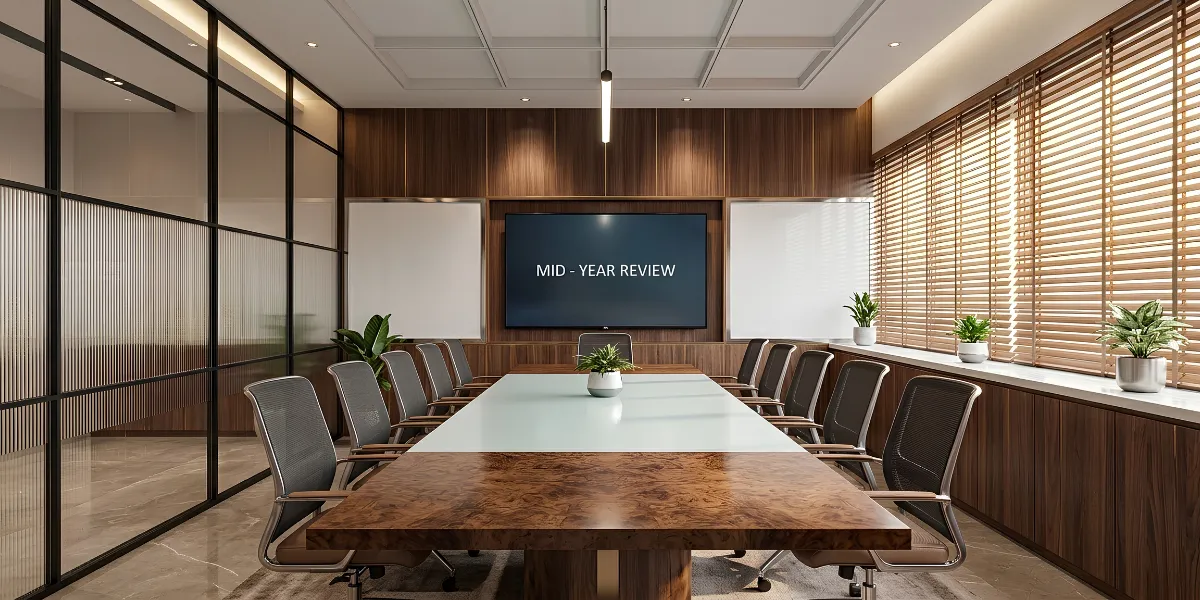
High-performing boards share one habit that average boards consistently skip. Around the midpoint of the year, they stop and ask a question that sounds obvious but rarely gets answered formally: Are we actually doing our job?
Not whether the company is performing – that conversation happens every quarter. Whether the board itself is working. Whether it is spending time on the right things. Whether the governance commitments made in January are still alive. Whether the agenda reflects the risks the organisation is actually facing, or the risks it was facing six months ago.
This is the board performance review that no regulatory framework mandates, but every effective governance structure benefits from. And in the GCC, where the operating environment has shifted considerably in the first half of 2026 – geopolitical pressure, accelerating AI adoption, tightening ESG disclosure expectations across the Tadawul and beyond – the mid-year reset is not a nice-to-have. It is the mechanism that separates boards that respond to events from boards that stay ahead of them.
What Drifts Between January and June
Every board starts the year with intentions. A well-structured H1 agenda. A skills review is committed to. A succession conversation scheduled. An independent board evaluation is planned. By June, most of those intentions have been overtaken by the quarterly reporting cycle, management-initiated approvals, and the accumulated weight of compliance obligations. The GCC BDI and Heidrick & Struggles Board Effectiveness Review 2025, covering 193 directors and executives across the region, found that 67% of GCC boards lack a formal succession plan and only 32% have formal director lifecycle processes. These figures do not represent boards that decided succession and director development were unimportant. They represent boards where the year moved faster than the governance calendar.
The pattern has a name: agenda drift. The board arrives at its mid-year meeting having spent most of H1 on what management needed from it, rather than what the board’s own governance mandate required. Board oversight strategy gets crowded out, not through negligence but through the absence of a mid-year moment that forces honest accounting.
PwC’s 2025 Annual Corporate Directors Survey found that 93% of executives advocated for replacing at least one board director, a figure that reflects, in part, a growing frustration with boards that are not adapting their composition, agenda quality, or oversight approach at the pace the business environment demands. The mid-year reset is the mechanism that allows boards to self-correct before that frustration compounds.
The Five Things High-Performing Boards Review at Mid-Year
Board effectiveness GCC conversations tend to focus on composition and compliance. High-performing boards go further. They review five things at mid-year that average boards defer until December, by which point the opportunity to act in the current year has usually passed.
1. The agenda against the risk register
Does the H1 agenda reflect the risks on the company’s risk register? Or has there been a disconnect between what the board discussed and what the organisation’s risk function considers the live exposures? The GCC BDI Board Effectiveness Review 2025 found that 40% of GCC directors cite regional instability as a top risk, yet only 15% of boards have a formal geopolitical risk framework. If geopolitical risk is in the register but not on the agenda, the mid-year review names that gap and creates the H2 space to address it.
2. Governance KPIs – what was committed, what was delivered
Most boards do not track governance KPIs with the same rigour they apply to financial performance. The mid-year review changes that. A simple accountability scan asks: which governance commitments from the year-start plan are complete, which are in progress, and which have been deferred without a decision? The output is not a grading exercise. It is a decision log, identifying what requires a board-level resolution to move forward before year-end.
3. Information quality
The GCC BDI Board Effectiveness Review 2025 found that performance management is a growing expertise gap for GCC directors, cited by 32%, up from 21% in 2023. When boards cannot interrogate what management presents, information quality tends to decline gradually. Board packs become longer but less substantive. The mid-year review asks whether the board is receiving the information it needs to exercise genuine oversight, or whether it has been receiving information that management is comfortable providing. These are different things.
4. Composition against the forward agenda
A skills matrix is only useful if it is current. The mid-year review asks whether the board’s composition still matches what H2 requires. If AI governance, ESG oversight, or geopolitical risk management are on the H2 agenda, and in most GCC boards they should be, does the table have the expertise to engage with those topics substantively? Board Intelligence’s inaugural Middle East Board Value Index (December 2025), surveying 100 GCC board directors, found that while 48% of directors view their boards as essential tools for value creation, the gap between confidence and documented capability remains a consistent governance risk across the region. MEIoD’s article on board composition trends in the GCC provides a deeper look at how boards should approach this exercise.
The chair’s honest assessment
The one review that rarely happens formally is the most valuable. The chair’s own assessment of whether the board is functioning, whether dynamics are healthy, whether independent directors are genuinely independent in practice, and whether the CEO relationship is working. This is not an agenda item. It is a private conversation that the best governance cultures make routine at the mid-year point, and that average board cultures defer indefinitely.
Why This Matters More in 2026 Than Any Previous Year
Corporate governance best practices in MENA have been under pressure from multiple directions simultaneously in 2026. Saudi Arabia’s CMA Corporate Governance Regulations continue to evolve through the authority’s 2024-2026 strategic plan. The GCC BDI identified 2026 explicitly as the midpoint of major strategic cycles launched across the region, the moment at which governance quality either catches up with strategic ambition or falls visibly behind it.
McKinsey and the GCC BDI’s State of AI in GCC Countries survey (August–September 2025), covering 139 senior executives and board directors, found that 84% of GCC organisations have adopted AI to some degree. Yet only 5% of boards have a fully implemented AI adoption plan. The gap between organisational AI adoption and board-level AI governance is widest at the mid-year point, because H1 typically produces AI deployment decisions that H2 must govern. A board that has not reviewed its AI oversight framework by June is behind the cycle, not ahead of it.
For corporate governance family businesses GCC, the mid-year reset has an additional dimension. The intersection of family dynamics and formal governance means that H1 often produces informal decisions, about succession, about family member roles, about capital allocation, that never formally reach the board. The mid-year review is the moment to bring those informal decisions into the governance record before they create exposure. MEIoD’s article on what Eid teaches boardrooms about stewardship explores this same intersection of family values and formal governance discipline from a different angle. MEIoD’s work on family business governance is built around this recurring accountability rhythm – ensuring that what happens informally in family-controlled businesses gets formalised through governance structures before it becomes a dispute.
From Reset to Action
A mid-year review that produces observations is not a reset. It is a discussion. The output that matters is a short list of specific decisions: changes to the H2 agenda, a director development commitment, a succession conversation scheduled, an information quality standard set and communicated to management.
For directors who identify specific competency gaps through the review, MEIoD’s Corporate Directors Program – CDP Part III provides structured development directly relevant to what mid-year reviews most consistently surface: internal control oversight, risk management, and strategic governance capability. The September cohort 2026 opens on 13 September.
For boards that want an independent view of where they stand rather than a self-assessment, MEIoD’s CG Assessment provides the external diagnostic on board performance that a self-conducted review cannot. It maps current governance practices against GCC regulatory requirements and produces a clear action roadmap, the kind of output that a mid-year reset should always generate but rarely does when conducted internally. MEIoD’s companion piece on post-AGM governance review offers a parallel, event-triggered version of this same discipline for boards looking to build a more consistent review cadence throughout the year.
For investors applying governance standards to portfolio companies, the mid-year is equally the right moment to review whether investee boards are tracking against the governance commitments made at the point of investment. MEIoD’s corporate governance for investors Middle East services are designed for exactly this, providing the external oversight that portfolio governance requires.
Strengthen Your Board with MEIoD
The boards that perform in H2 are the ones that honestly reviewed H1 in June. Not the ones with the best intentions in January.
- CG Assessment – an independent diagnostic of governance gaps with a specific H2 improvement roadmap, benchmarked against current GCC regulatory standards
- Board Evaluations – independent assessment of board effectiveness at any point in the governance year, not just at year-end
- Corporate Directors Program – CDP Part III – structured development for directors, closing competency gaps identified through a mid-year review. July cohort: 12 July; September cohort: 13 September
- Family Business Governance Structure – for family-controlled boards, ensuring informal H1 decisions are formalised before they create governance exposure
Not sure which of the five mid-year priorities applies most urgently to your board? Start with MEIoD’s CG Quiz for a quick self-assessment. The reset starts with a conversation. Contact MEIoD to structure yours.
FAQ
What should a GCC board review at mid-year?
The five most valuable mid-year reviews are: the board agenda against the company risk register, governance KPIs and year-start commitments, information quality and whether management reporting supports genuine oversight, board composition against the H2 strategic agenda, and the chair’s honest assessment of board dynamics. The GCC BDI Board Effectiveness Review 2025 found that 67 percent of GCC boards lack succession plans and only 32 percent have formal director lifecycle processes – both gaps that a structured mid-year review would surface and act on.
Why is the mid-year governance review important for GCC boards, specifically in 2026?
The GCC BDI identified 2026 as the midpoint of major strategic cycles across the region – the moment governance quality either catches up with strategic ambition or falls behind it. McKinsey and GCC BDI’s State of AI in GCC Countries survey (2025) found that 84% of GCC organisations have adopted AI, but only 5% of boards have a fully implemented AI adoption plan. The mid-year is when H1 AI deployment decisions need board-level governance frameworks in place for H2.
How is a mid-year board review different from a formal annual evaluation?
The annual evaluation is formal, structured, and typically feeds into year-end reporting and regulatory disclosure. The mid-year review is operational and forward-looking – its output is a set of specific decisions that improve H2 governance quality. PwC’s 2025 Annual Corporate Directors Survey found that nine out of ten executives believe board assessment processes could be improved, and that the greatest opportunity comes when assessments drive meaningful action rather than documentation.
How does MEIoD support mid-year board reviews in the GCC?
MEIoD’s CG Assessment provides an independent diagnostic of governance gaps mapped against current GCC regulatory frameworks, with a specific H2 action roadmap. For directors who identify competency gaps through the review, the Corporate Directors Program – particularly CDP Part III covering internal control, risk management, and oversight strategy – provides structured development with cohorts opening in July and September 2026. For family-controlled businesses and investor portfolios, MEIoD offers governance services tailored to the mid-year accountability rhythm both categories require.